

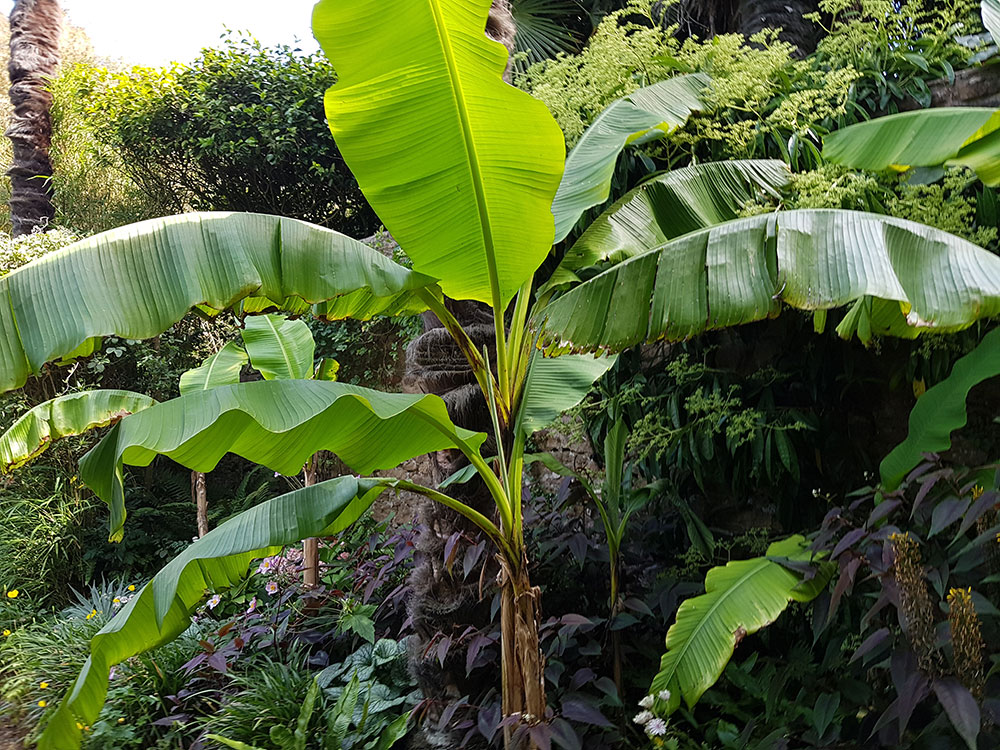
Perennial
Musa basjoo
Japanese fibre banana
A vigorous banana with huge green leaves and clumping pseudostems for a lush summer canopy.
- Full sun
- 2.5–5 m (8–16 ft)
- 2–4 m (7–13 ft)
- H4 · Zone 6
- July–September
- Deciduous
- RHS Award of Garden Merit
Overview
This Chinese banana rapidly produces large leaves from fleshy pseudostems. Mature retained stems may flower and form small, seedy, inedible fruit in warm summers. The cold rating refers to an established, deeply mulched rootstock; foliage and unprotected stems are frost tender, so winter wrapping preserves height.
At a Glance

Growing Conditions
Aspect Suitability
- South-facing
- West-facing
Soil Tolerance
- Chalk
- Sandy
- Loam
- Acid
- Neutral pH
- Alkaline
Foliage


- Architectural foliage
Foliage interest: May–November
Seasonal Timeline
- Flowering Jul Aug Sep
- Foliage May Jun Jul Aug Sep Oct Nov
- Fruiting Sep Oct Nov
- Propagate May Jun Jul
How to propagate
Ways to grow more Japanese fibre banana: the usual steps for each method.
Offsets, runners and bulblets Mar–Apr, Aug–Sep Easy
You'll need: A trowel, small pots and compost.
- Find the small plants, offsets or bulblets growing beside the parent plant, or on its runners.
- Gently separate them with some roots, cutting any runner from the parent.
- Pot them up, or replant them at the same depth, and water.
- How long
- Grows on within a few weeks.
- It's worked when
- New leaves on the young plants.
- Then
- Grow them on until they're a good size before planting out.
Division Mar–Apr, Sep–Oct Easy
You'll need: A garden fork or spade (two forks back to back help with big clumps) and a sharp knife.
- Water the plant well the day before.
- Dig up the whole clump with a fork, keeping as much root as you can.
- Split it into pieces about the size of your fist, each with healthy roots and shoots: pull them apart by hand, or cut tough clumps with a knife or spade.
- Throw away any old, woody middle.
- Replant the pieces straight away at the same depth, and water them in well.
- How long
- Settles in within a few weeks.
- It's worked when
- Fresh new growth within a few weeks.
- Then
- Water in dry spells for the rest of the season.
Remove offsets with their own roots in warm weather. Keep divisions sheltered and well watered until growth resumes.
Maintenance Calendar
- Apr Unwrap gradually as frost risk falls and inspect stems
- May Feed generously and mulch around actively growing clumps
- Jun Water deeply and frequently in warm dry weather
- Jul Remove rooted offsets if more plants are needed
- Oct Wrap retained stems with dry insulation and a ventilated rain cap
- Nov Mulch the rootstock deeply without trapping standing water
- Dec Check insulation remains dry and securely supported
Garden Design
Works well in: Japanese / Zen, Modern / Contemporary, Tropical / Exotic
Allow a broad leaf canopy and protect from strong winds that shred leaves. Wrapping stems gives earlier height than annual regrowth from ground level.
Companion planting: Cannas, Gingers, Tree ferns, Large grasses
Wildlife Value
- Shelter
Safety
No well-established major toxicity. Fruit is seedy and unsuitable as a dessert banana; wet fallen leaves can be slippery.