

Climber · Evergreen shrub
Trachelospermum jasminoides
Star jasmine
Also known as: Rhynchospermum jasminoides
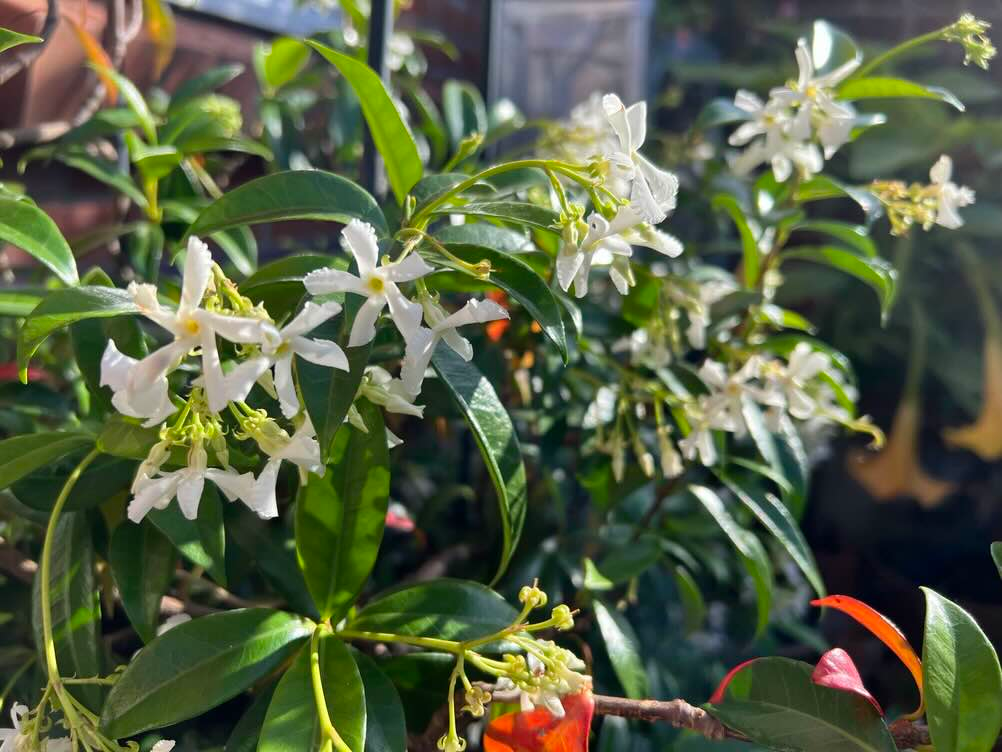
A vigorous evergreen climber with glossy dark green leaves and masses of sweetly fragrant white, jasmine-like flowers in summer.
- Full sun, Partial shade
- 3–9 m (10–30 ft)
- 1.5–3 m (5–10 ft)
- H4 · Zone 8
- June–August
- Evergreen
- RHS Award of Garden Merit
Overview
Star jasmine is a popular evergreen climber grown for its handsome glossy foliage and abundant clusters of small, pinwheel-shaped white flowers that fill the garden with a delicious sweet scent through summer. Despite the common name, it isn't a true jasmine, but belongs to the same plant family as periwinkle and oleander. Twining stems cling and scramble happily over trellis, walls, fences and pergolas, making it an excellent choice for softening boundaries or framing a doorway.
In autumn the foliage often takes on attractive bronze-red tints, especially in a sunny spot, adding a second season of interest once the flowers have finished. It is a reasonably slow starter but picks up pace once established, eventually reaching a good height if given support and shelter.
This is a plant for a sheltered, sunny or partly shaded spot, ideally against a warm wall, as it is not fully hardy everywhere in the UK and can suffer in prolonged hard frosts, particularly when young. It also grows very well in a large container, making it useful for patios, courtyards or anywhere a touch of fragrant, evergreen cover is wanted.
At a Glance
Growing Conditions
Aspect Suitability
- East-facing
- South-facing
- West-facing
Site Tolerance
- Coastal
- Drought
Soil Tolerance
- Clay
- Chalk
- Sandy
- Loam
- Acid
- Neutral pH
- Alkaline
Foliage
- Autumn colour
Foliage interest: 12 months of the year
Seasonal Timeline
- Flowering Jun Jul Aug
- Foliage 12 months of the year
- Fruiting Sep Oct
- Propagate Jun Jul Aug Sep
How to propagate
Ways to grow more Star jasmine:
Semi-ripe cuttings Jun–Sep Takes a little care
You'll need: Sharp secateurs, rooting hormone powder, free-draining cuttings compost (perlite plus peat-free compost) and a propagator or clear plastic bag for humidity.
- Choose healthy, non-flowering shoots that are firm at the base but still soft at the tip, about 10-15cm long.
- Cut just below a leaf node, then remove the lower leaves so only two or three pairs remain at the top.
- Trim the cutting just below a node and dip the cut end in rooting hormone powder.
- Insert cuttings around the edge of a pot filled with a free-draining compost and perlite mix.
- Cover with a propagator lid or clear plastic bag to keep humidity high, and place somewhere warm and bright but out of direct sun.
- Keep the compost just moist and check every week or two for new growth, a sign roots are forming.
- How long
- Takes roughly six to ten weeks to root.
- It's worked when
- Gentle resistance when you tug the cutting, plus fresh new leaf growth at the tip.
- Then
- Once rooted, pot each cutting individually into peat-free compost and grow on in a sheltered spot or cold frame over winter, protecting from hard frost in the first year, before planting out the following late spring.
Layering Jun–Aug Easy
You'll need: A low, flexible stem still attached to the parent plant, a peg or stone to hold it down, and moist soil.
- In summer, choose a long, low, flexible stem growing near the base of the plant.
- Lightly wound or nick the underside of the stem at the point where it will touch the soil.
- Bend the stem down and bury this wounded section a few centimetres deep, leaving the growing tip exposed above the soil.
- Pin the buried section firmly in place with a peg, loop of wire, or a stone.
- Keep the soil around the layered stem consistently moist through summer and into autumn.
- Check in autumn for resistance and new roots, then leave in place over winter before severing.
- How long
- Roots naturally over a few months, usually by the following spring.
- It's worked when
- Firm resistance when you gently tug the layered stem and visible new roots when you carefully part the soil.
- Then
- Once well rooted, sever the new plant from the parent with sharp secateurs, lift carefully and pot up or transplant to its final position, watering well until established.
Take semi-ripe cuttings in summer, dip the cut ends in rooting hormone and place in a free-draining compost mix under cover until rooted. Alternatively, pin a low-growing stem to the soil in summer and it will often root naturally within a few months, ready to sever from the parent plant the following spring.
Maintenance Calendar
- Feb Trim any frost-damaged shoots before new growth starts
- Mar Apply a balanced slow-release fertiliser around the base
- Mar Refresh mulch to lock in moisture as growth resumes
- Apr Tie in new shoots to their support framework
- May Water regularly to settle in new spring growth
- May Check new shoots for aphids and treat if needed
- Jun Continue training stems along trellis or wires
- Jul Water deeply during dry spells, especially in containers
- Jul Inspect leaves and stems for scale insects or mealybug
- Aug Take semi-ripe cuttings from healthy shoots
- Aug Layer a low stem into the soil to root naturally
- Sep Trim back straggly growth once flowering has finished
- Oct Top up mulch to insulate roots for winter
- Nov Wrap containers or cover exposed plants with fleece
Garden Design
Works well in: Cottage, Mediterranean, Modern / Contemporary, Tropical / Exotic
Trains beautifully over walls, fences, arches and pergolas, bringing glossy year-round foliage and a wonderful summer scent. Works well combined with roses or clematis for layered interest, or grown alone as a fragrant focal point near seating areas and doorways.
Companion planting: Climbing roses, Clematis, Mediterranean shrubs, Other scented climbers
Wildlife Value
- Bees
- Other pollinators
- Beneficial insects
- Shelter
- RHS Plants for Pollinators
- Nesting cover for birds
Spreads or self-seeds freely: keep it in check.
Safety
- Toxic to humans
- Toxic to dogs
- Toxic to cats
- Toxic to horses
- Skin irritant
All parts contain a milky sap that is toxic if eaten and may irritate skin on contact, so wear gloves when pruning. Keep away from children and pets who might chew the leaves or stems.