

Evergreen shrub · Tree
Magnolia grandiflora ‘Ferruginea’
Southern Magnolia 'Ferruginea', Bull Bay 'Ferruginea'
Also known as: Magnolia grandiflora 'Fastigiata'
A handsome evergreen magnolia with glossy, rust-backed leaves and huge, fragrant creamy-white flowers from summer into autumn.
- Full sun, Partial shade
- 8–15 m (26–49 ft)
- 4–8 m (13–26 ft)
- H5 · Zone 7
- June–September
- Evergreen
- RHS Award of Garden Merit
Overview
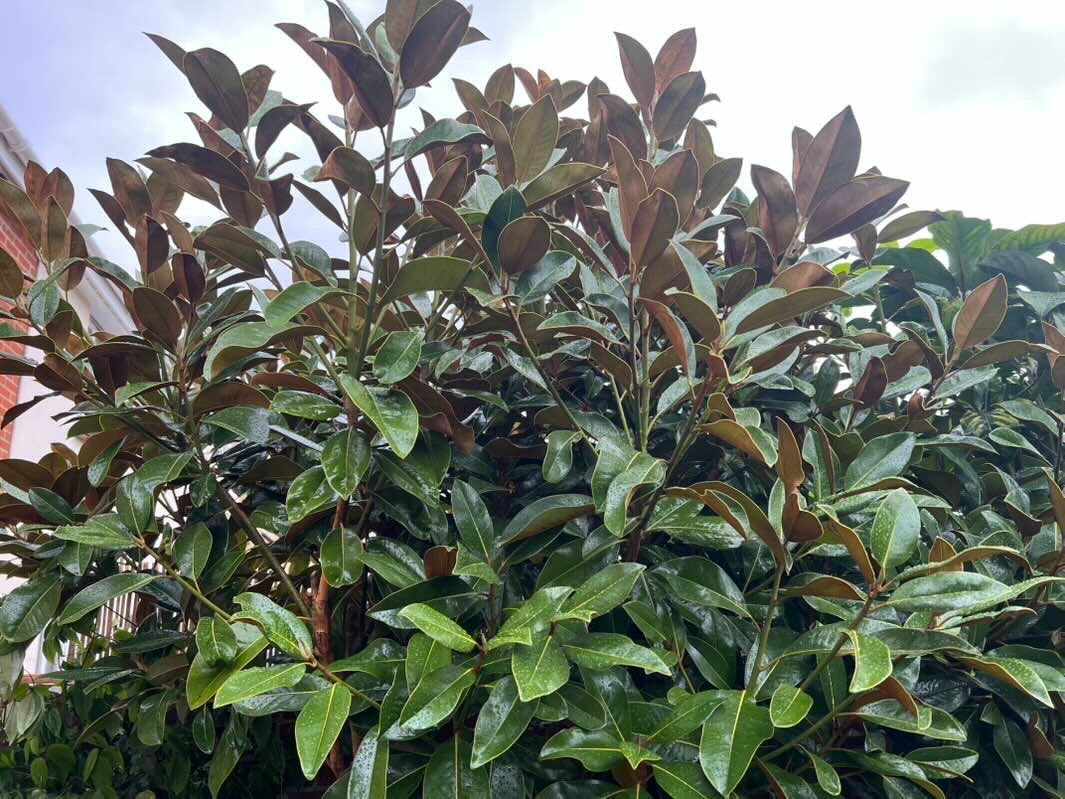
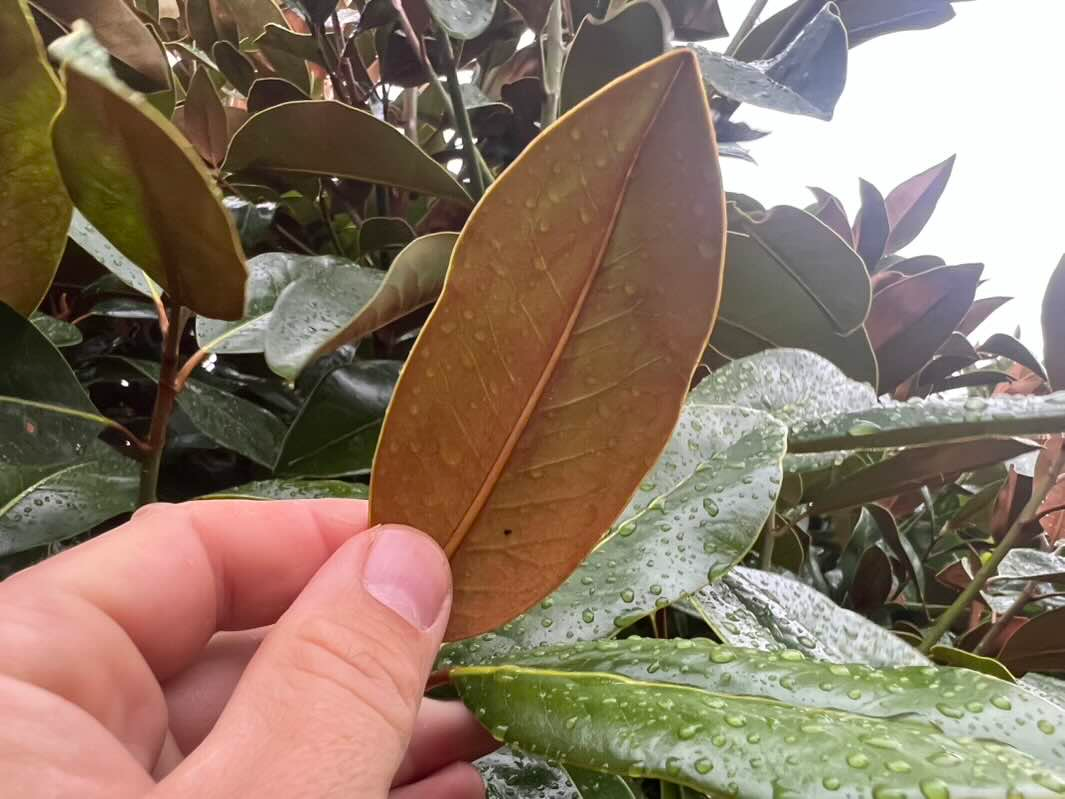
Magnolia grandiflora 'Ferruginea' is a striking evergreen tree (or large shrub if pruned) prized for its bold, leathery leaves. The upper leaf surface is a deep glossy green, while the underside is covered in a dense, rust-coloured (ferruginous) felt, giving the whole plant real year-round interest even before it flowers.
From midsummer through to early autumn it produces huge, goblet-shaped, creamy-white flowers that can reach 20cm or more across, each filled with a rich lemony fragrance that carries on warm evenings. 'Ferruginea' tends to flower at a younger age and more freely than the species, and is also considered slightly hardier and more compact, making it a good choice for cool temperate gardens.
It makes a superb specimen tree against a sunny, sheltered wall or as a free-standing feature in a larger garden, where its dense evergreen habit also provides useful screening. Given time and the right conditions it can reach a substantial size, so it is best suited to gardens with room to let it develop.
At a Glance
Growing Conditions
Aspect Suitability
- South-facing
- West-facing
Site Tolerance
- Coastal
- Drought
Soil Tolerance
- Clay
- Chalk
- Sandy
- Loam
- Acid
- Neutral pH
- Alkaline
Foliage
- Architectural foliage
Foliage interest: 12 months of the year
Seasonal Timeline
- Flowering Jun Jul Aug Sep
- Foliage 12 months of the year
- Fruiting Sep Oct Nov
- Propagate Jul Aug Sep
How to propagate
Ways to grow more Southern Magnolia 'Ferruginea', Bull Bay 'Ferruginea':
Semi-ripe cuttings Jul–Sep Tricky
You'll need: Sharp secateurs, rooting hormone powder or gel, free-draining cutting compost, a heated propagator or bottom heat mat, and a cold frame or greenhouse.
- In late summer, choose healthy, non-flowering side shoots that are firm at the base but still slightly flexible at the tip
- Pull each cutting away with a small heel of older bark, or cut just below a leaf node, making cuttings about 10-15cm long
- Trim the heel neatly, remove lower leaves and reduce any very large remaining leaves by half to cut down on water loss
- Dip the cut end in rooting hormone, then insert into a pot of gritty, free-draining cutting compost
- Place in a heated propagator with gentle bottom heat around 18-21°C, keeping the compost just moist and the air humid
- Check every few weeks, misting lightly and removing any fallen leaves to prevent rot
- How long
- Rooting is slow and can take several months, often over winter.
- It's worked when
- A gentle tug meets resistance and you may see new leaf growth starting from the tip.
- Then
- Once well rooted, pot on into a small pot of loam-based compost, grow on in a sheltered cold frame or unheated greenhouse for the first winter, and plant out the following spring once the root system is established.
Layering Mar–May Takes a little care
You'll need: A low, flexible branch close to the ground, a sharp knife, rooting hormone, and a peg or stone to hold the branch down.
- In spring, choose a low, young, flexible branch that can be bent down to touch the soil
- Wound the underside of the branch lightly where it will touch the ground, or make a small shallow cut, and dust with rooting hormone
- Dig a shallow trench, peg or weigh the wounded section down into the soil, leaving the growing tip upright above ground
- Cover the pegged section with soil, firm gently, and keep consistently moist throughout the growing season
- Check occasionally for root development, which may take a full year or more before the layer is ready to sever
- How long
- Rooting is slow, often taking a full year or two before the layer can be separated.
- It's worked when
- Gentle resistance when you lift the layered section, and new shoot growth appearing from the buried part.
- Then
- Once rooted, sever the new plant from the parent with sharp secateurs, lift carefully with its root ball intact, pot up into loam-based compost, and grow on in a sheltered spot for a season before planting out.
Take semi-ripe cuttings with a heel in late summer, dip in rooting hormone and root in a heated propagator with bottom heat, though rooting can be slow and unreliable. Layering low branches in spring is a reliable, if slow, way to get a new plant that comes true to the cultivar. As 'Ferruginea' is a named cultivar it won't come true from seed, so grafting onto Magnolia grandiflora rootstock is sometimes used commercially for faster, more reliable results.
Maintenance Calendar
- Jan Protect young plants from hard frosts and cold winds
- Jan Protect young plants from hard frosts and cold winds
- Feb Apply a thick mulch of well-rotted organic matter around the base
- Feb Apply a thick mulch of well-rotted organic matter around the base
- Mar Apply a balanced, slow-release fertiliser as growth begins
- Mar Apply a balanced, slow-release fertiliser as growth begins
- Mar Remove any dead, damaged or crossing branches if needed
- Mar Remove any dead, damaged or crossing branches if needed
- Apr Water newly planted specimens regularly in dry spells
- Apr Water newly planted specimens regularly in dry spells
- Apr Check and adjust stakes on young trees for stability
- Apr Check and adjust stakes on young trees for stability
- May Check leaves for scale insects and sooty mould
- May Check leaves for scale insects and sooty mould
- Jun Water well during dry periods, especially newly planted trees
- Jun Water well during dry periods, especially newly planted trees
- Jun Inspect foliage for leaf spot or discolouration
- Jun Inspect foliage for leaf spot or discolouration
- Jul Take semi-ripe cuttings with a heel for propagation
- Jul Take semi-ripe cuttings with a heel for propagation
- Jul Lightly trim or shape hedges and screens after flowering begins
- Jul Lightly trim or shape hedges and screens after flowering begins
- Aug Continue taking semi-ripe cuttings and set up layers
- Aug Continue taking semi-ripe cuttings and set up layers
- Aug Keep watering during hot, dry spells to support flowering
- Aug Keep watering during hot, dry spells to support flowering
- Sep Collect seed cones for interest or propagation trials
- Sep Collect seed cones for interest or propagation trials
- Sep Top up mulch layer to retain moisture and suppress weeds
- Sep Top up mulch layer to retain moisture and suppress weeds
- Oct Carry out any structural pruning once flowering has finished
- Oct Carry out any structural pruning once flowering has finished
- Oct Check for signs of fungal leaf spot before winter
- Oct Check for signs of fungal leaf spot before winter
- Nov Protect young or newly planted trees with fleece in cold areas
- Nov Protect young or newly planted trees with fleece in cold areas
- Dec Check ties and stakes are secure ahead of winter storms
- Dec Check ties and stakes are secure ahead of winter storms
Garden Design
Works well in: Cottage, Mediterranean, Modern / Contemporary, Wildlife-friendly
A magnificent specimen tree that commands attention as a focal point, with glossy evergreen foliage and dramatic rust-coloured leaf undersides adding year-round interest. Best given plenty of space to show off its stately conical form, used as a stand-alone specimen or clipped as a dense screen or hedge against a sunny, sheltered wall.
Companion planting: Evergreen shrubs, Climbers, Spring bulbs, Shade-tolerant perennials
Wildlife Value
- Other pollinators
- Birds
- Beneficial insects
- Shelter
- Food source
- Nesting cover for birds
Food for birds: September–November
Safety
Magnolia grandiflora is not known to be toxic to people or common pets, though as with any plant it's wise to discourage children or animals from eating leaves, flowers or seed pods. The dense evergreen canopy and thick branches make it a good, safe nesting and shelter spot for birds.