

Shrub
Abutilon ‘Lilli’
Lilli flowering maple
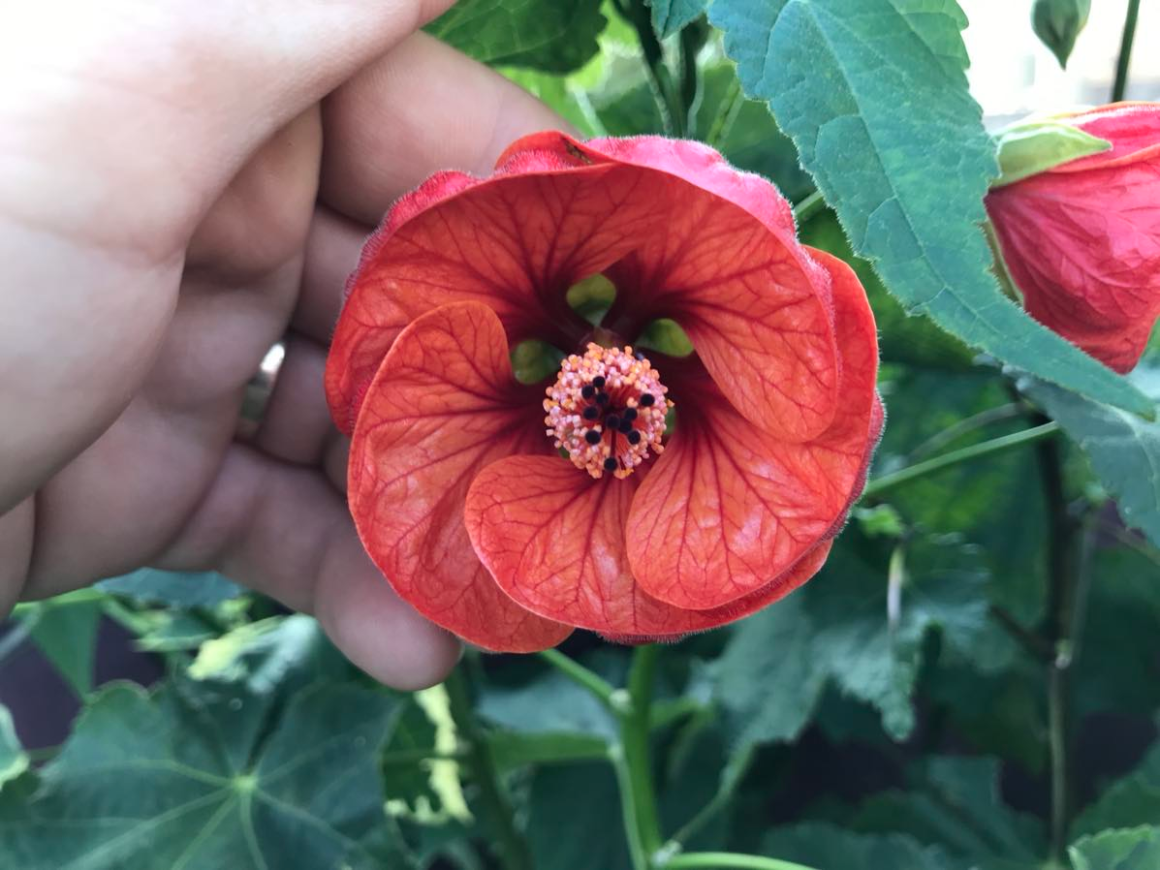
An upright flowering maple with open, nodding bells in a warm red-orange, their petals overlapping in a swirl.
- Full sun, Partial shade
- 1–1.8 m (3–6 ft)
- 0.6–1 m (2–3 ft)
- H3 · Zone 9
- April–October
- Evergreen
Overview
This flowering maple forms a well-branched, upright evergreen shrub with maple-like leaves. Over a long season from spring to autumn it carries open, nodding, bell-shaped flowers in a warm shade between red and orange, their broad petals overlapping in a swirling pattern. It is hardy to about -5°C (23°F) in a sheltered spot, so in cool temperate climates it suits mild gardens and warm walls, or a pot that can be moved under cover for winter, where it often keeps flowering. In frost-free climates it flowers for much of the year.
At a Glance
Growing Conditions
Aspect Suitability
- East-facing
- South-facing
- West-facing
Soil Tolerance
- Chalk
- Sandy
- Loam
- Acid
- Neutral pH
- Alkaline
Foliage
Foliage interest: 12 months of the year
Seasonal Timeline
- Flowering Apr May Jun Jul Aug Sep Oct
- Foliage 12 months of the year
- Propagate Apr May Jun Jul Aug
How to propagate
Ways to grow more Lilli flowering maple: the usual steps for each method.
Softwood cuttings Apr–Jun Takes a little care
You'll need: Clean, sharp secateurs or a knife, small pots, gritty compost (half compost, half grit or perlite), a plastic bag, and rooting powder if you have it.
- Early in the morning, cut soft, non-flowering shoot tips about 5 to 10 cm long, and keep them in a plastic bag so they don't wilt.
- Trim each one just below a leaf joint and take off the lower leaves, leaving two or three at the top.
- Dip the cut end in rooting powder if you have some.
- Push them into the edge of a pot of gritty compost so their leaves don't touch, and water them in.
- Cover with a clear bag or put them in a propagator, somewhere bright but out of direct sun.
- How long
- Roots in about 3 to 6 weeks.
- It's worked when
- New growth at the tips, and roots showing through the pot's holes.
- Then
- Pot each one up on its own and grow it on. Keep young plants frost-free through their first winter.
Semi-ripe cuttings Jul–Aug Takes a little care
You'll need: Clean, sharp secateurs, small pots, gritty compost, and rooting powder if you have it.
- Choose this year's shoots that are firm at the base but still soft at the tip, and cut pieces 10 to 15 cm long.
- Trim just below a leaf joint and take off the lower leaves; pinch out the soft tip.
- Dip the cut end in rooting powder if you have some.
- Push them into pots of gritty compost, water them in and cover with a clear bag.
- Keep them in a cold frame, greenhouse or bright windowsill out of direct sun.
- How long
- Roots in about 6 to 10 weeks.
- It's worked when
- New leaves, and the cutting resists when you tug it gently.
- Then
- Keep them somewhere cool and frost-free over winter, and pot them up separately in spring.
Take cuttings in spring or summer and root them in warmth. Keep a young plant under cover as winter insurance.
Maintenance Calendar
- Mar Prune hard in early spring, then pinch back lightly through the season to keep a bushy shape
- May Water well and feed every two weeks with a high-potash fertiliser while flowering
- Jul Check leaf undersides for whitefly and red spider mite, especially under glass
- Oct Move pots under frost-free cover before hard frosts, where it may keep flowering in a bright spot
Garden Design
Works well in: Cottage, Modern / Contemporary, Tropical / Exotic
A long-flowering patio shrub; the warm red-orange bells suit hot-coloured schemes with cannas and salvias.
Companion planting: Salvias, Cannas, Fuchsias, Grasses
Wildlife Value
- Bees
- Other pollinators
- Birds
Safety
Not known to be toxic; ornamental only.