

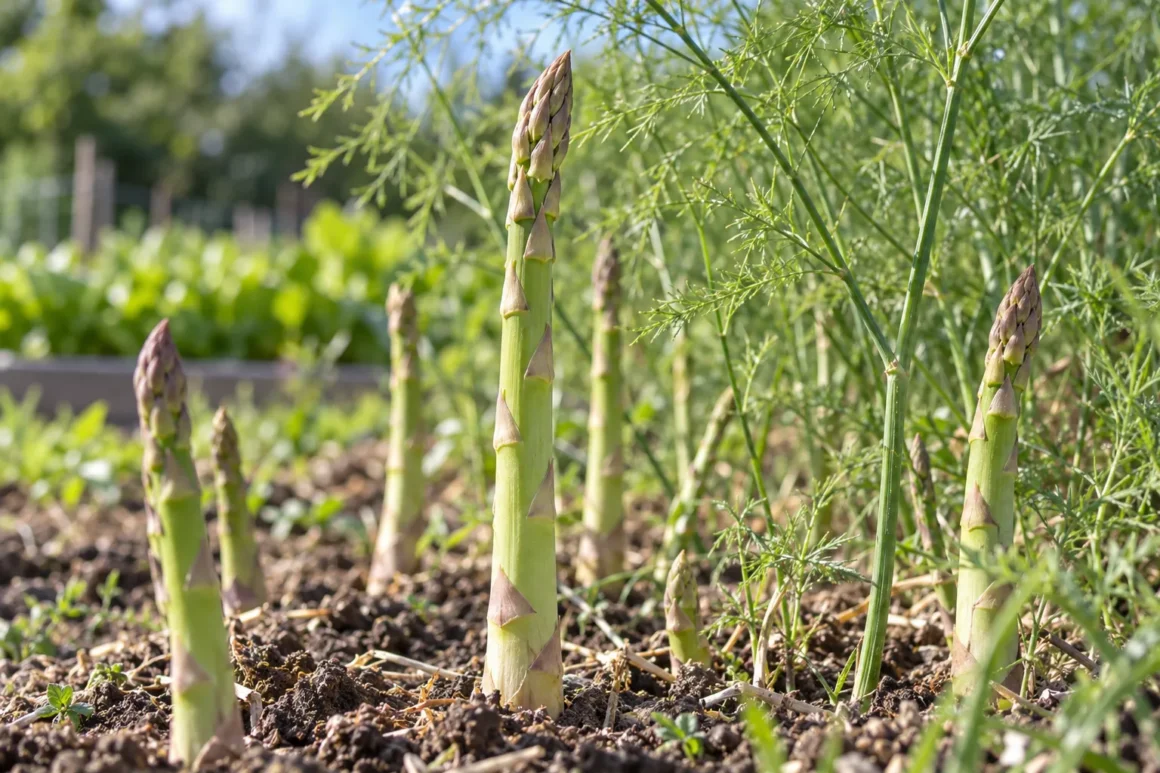
Perennial · Vegetable
Asparagus officinalis
Asparagus
A long-lived, very hardy perennial vegetable cropping tender spears in spring for 20 years or more, followed by tall, feathery ferns.
- Full sun
- 1.2–1.8 m (4–6 ft)
- 60–90 cm (24–35 in)
- H7 · Zone 3
- June–July
- Deciduous
Overview
Asparagus is native to Europe, North Africa and western Asia and is one of the few long-lived perennial vegetables. Each spring the crowns push up tender green, white or purple spears, which are cut for about six to eight weeks; the rest are left to grow into tall, airy, feathery fronds that feed the crown and turn golden in autumn. Female plants produce red berries, so modern all-male varieties are often grown for bigger yields and no self-sown seedlings. It is extremely hardy (below -30°C / -22°F) and needs a winter rest, either from cold or, in warm climates, from summer drought. A bed takes two to three years to start cropping but lasts for decades, so choose a sunny, well-drained, weed-free spot. Spear colour and yield depend on the variety.
At a Glance
Growing Conditions
Aspect Suitability
- South-facing
- West-facing
Site Tolerance
- Coastal
- Salt
Soil Tolerance
- Sandy
- Loam
- Neutral pH
- Alkaline
Foliage
- Autumn colour
Foliage interest: June–October
Seasonal Timeline
- Flowering Jun Jul
- Foliage Jun Jul Aug Sep Oct
- Fruiting Aug Sep Oct
- Propagate Mar Apr
- Harvest Apr May Jun
How to propagate
Ways to grow more Asparagus: the usual steps for each method.
Division Mar–Apr Easy
You'll need: A garden fork or spade (two forks back to back help with big clumps) and a sharp knife.
- Water the plant well the day before.
- Dig up the whole clump with a fork, keeping as much root as you can.
- Split it into pieces about the size of your fist, each with healthy roots and shoots: pull them apart by hand, or cut tough clumps with a knife or spade.
- Throw away any old, woody middle.
- Replant the pieces straight away at the same depth, and water them in well.
- How long
- Settles in within a few weeks.
- It's worked when
- Fresh new growth within a few weeks.
- Then
- Water in dry spells for the rest of the season.
From seed Mar–Apr Easy
You'll need: Seed compost, a seed tray or small pots, labels, and a clear lid or plastic bag.
- Fill a tray or pots with seed compost, level it and firm it gently.
- Water the compost and let it drain.
- Sow the seeds thinly on top. Cover them with a fine layer of compost or vermiculite about as deep as the seed is big; leave tiny seeds uncovered.
- Label them, cover with a clear lid or bag, and keep them somewhere bright but out of hot sun.
- Keep the compost just moist, and take the cover off once seedlings appear.
- How long
- Usually comes up in 1 to 3 weeks.
- It's worked when
- Seedlings with their first pair of leaves.
- Then
- When each has its first true leaves, prick them out into their own small pots, holding them by a leaf, never the stem. Harden them off for a week or two before planting out.
Most gardeners plant one-year-old dormant crowns in early spring, spreading the roots over a ridge in a trench 20cm (8in) deep. Seed is cheaper but adds a year before cropping, and seedlings are a mix of male and female plants.
Maintenance Calendar
- Mar Plant dormant crowns in a trench in early spring, covering gradually as the shoots grow
- Mar Top-dress established beds with compost or manure before spears appear
- Apr From the third year, cut spears when 15-20cm (6-8in) tall for six to eight weeks, then stop
- May Hand-weed carefully, as the shallow crowns are easily damaged by hoeing
- Jun Check ferns for asparagus beetle adults and larvae and pick them off
- Jul Support the ferns with string in windy sites so they do not snap
- Nov Cut ferns to the ground once they turn yellow, before berries drop seed
Garden Design
Works well in: Cottage, Edible / Kitchen Garden
Give it a dedicated, permanent bed at the edge of the vegetable garden, where the tall summer ferns form an airy screen without shading other crops.
Companion planting: Tomatoes, Parsley, Basil, Avoid planting next to onions and garlic
Wildlife Value
- Bees
- Other pollinators
Safety
- Toxic to humans
- Toxic to dogs
- Toxic to cats
Spears are edible. The red berries on female plants are poisonous to people and pets, so remove them or grow all-male varieties where children or animals visit.