

Houseplant · Succulent
Aeonium arboreum
Tree houseleek
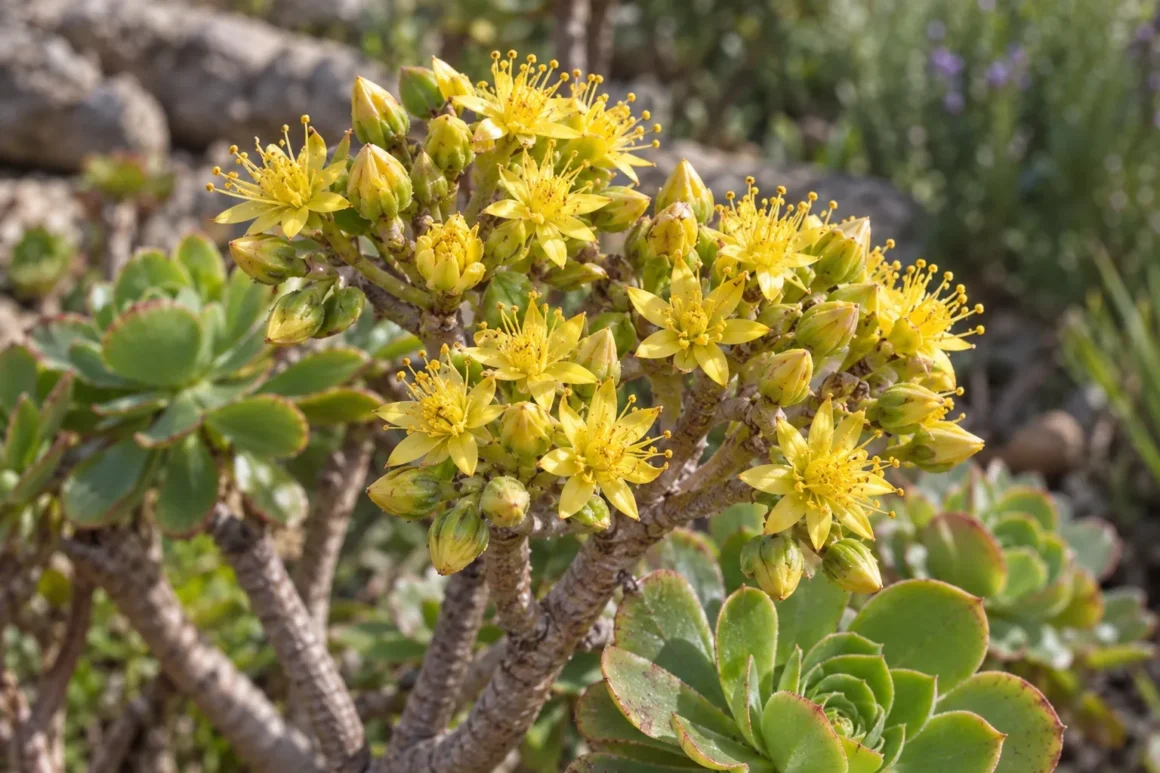
A branching succulent topped with flat rosettes of glossy green leaves, a favourite for sunny pots and dry gardens.
- Full sun
- 1–1.5 m (3–5 ft)
- 1–1.5 m (3–5 ft)
- H1c · Zone 11
- February–April
- Evergreen
- RHS Award of Garden Merit
Overview
Tree houseleek is a branching succulent from the Canary Islands, each stem ending in a flat rosette of fleshy, spoon-shaped green leaves. Mature rosettes produce cone-shaped heads of yellow flowers in late winter and spring, then that rosette dies while the rest of the plant carries on.
It needs a minimum of about 5°C (41°F), USDA zones 9–11. It grows in the cool, moist season and rests in summer heat, so in Mediterranean climates and California it is a garden plant; elsewhere it is grown in pots and brought in for winter.
Give bright light or light shade in hot climates and gritty, free-draining compost.
At a Glance
Growing Conditions
Aspect Suitability
- South-facing
- West-facing
Site Tolerance
- Coastal
- Drought
Soil Tolerance
- Sandy
- Loam
- Acid
- Neutral pH
- Alkaline
Foliage
- Architectural foliage
Foliage interest: 12 months of the year
Seasonal Timeline
- Flowering Feb Mar Apr
- Foliage 12 months of the year
- Propagate Apr May Jun Sep
How to propagate
One way to grow more Tree houseleek:
Leaf cuttings Apr Easy
You'll need: Sharp knife, cactus compost
- Cut a rosette with 5 cm (2 in) of stem
- Leave it to dry for several days
- Insert in gritty compost and water sparingly
- How long
- 10 minutes
- It's worked when
- high
- Then
- Keep in bright light.
Rosette cuttings root easily; let the cut end dry for a few days first.
Garden Design
Works well in: Desert / Dry, Mediterranean, Modern / Contemporary, Tropical / Exotic
Branching stems topped with flat green rosettes like wooden flowers. Superb in pots on a sunny terrace.
Companion planting: Agaves, Echeverias, Pelargoniums, Grasses
Wildlife Value
- Bees