

Evergreen shrub · Shrub
Leptospermum scoparium
Manuka
Also known as: Leptospermum scoparium var. scoparium, New Zealand tea tree, Manuka tea tree
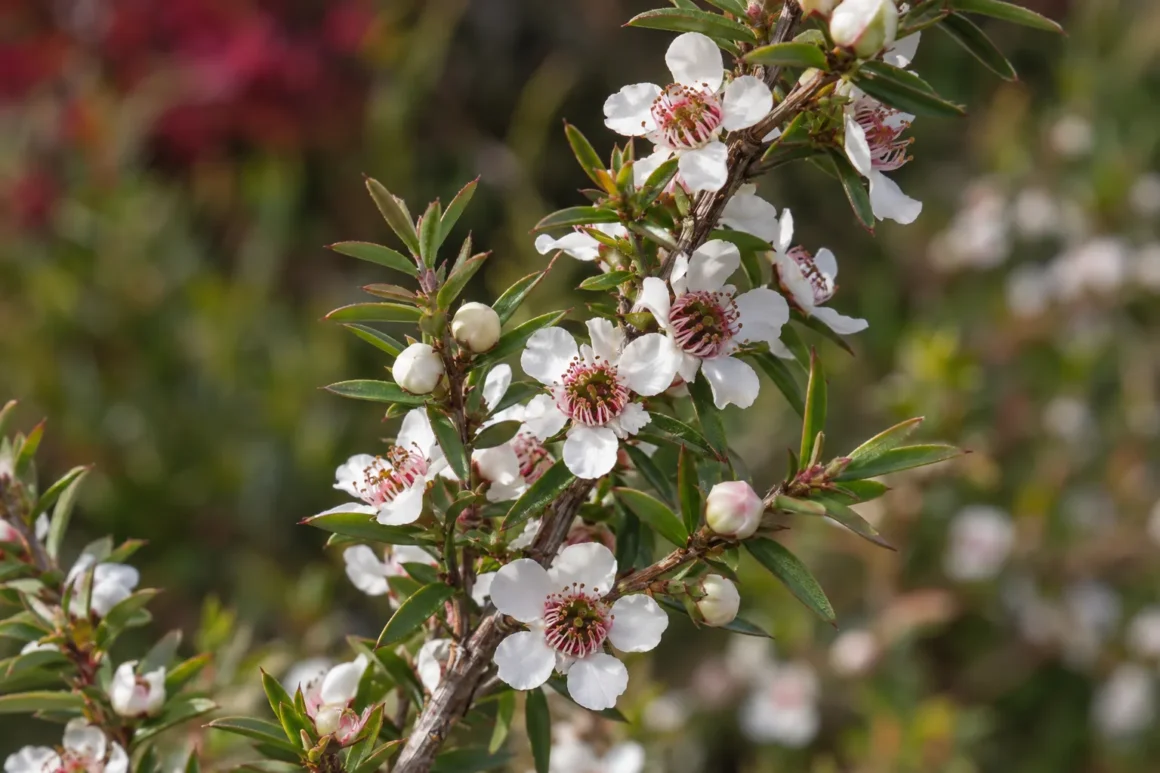
Manuka is a dense, evergreen New Zealand shrub famous for producing the nectar used to make manuka honey. It's a beautiful garden plant with delicate flowers and fine foliage.
- Full sun, Partial shade
- 1.5–3 m (5–10 ft)
- 1.5–2.5 m (5–8 ft)
- H4 · Zone 8
- May–July
- Evergreen
Overview
Manuka (Leptospermum scoparium) is a bushy, evergreen shrub from New Zealand, grown in the UK for its fine, aromatic foliage and masses of small, saucer-shaped flowers in early summer. The tiny leaves are narrow and pointed, giving the plant a soft, feathery texture, while the flowers – usually white, though some forms are pink or red – attract bees in great numbers and are the source of prized manuka honey.
After flowering, small woody seed capsules form and persist on the stems, adding texture and winter interest to the shrub even when it's not in bloom. Manuka has a naturally dense, twiggy habit with attractive peeling bark on older wood, making it useful as an informal specimen, in mixed borders or as part of a coastal or Mediterranean-style planting scheme.
In the UK it needs a sheltered, sunny spot with free-draining soil, as it dislikes winter wet and heavy clay. It's reasonably hardy but can be damaged by hard frosts, so a sunny wall or sheltered courtyard suits it well in colder areas. Once established it copes well with dry spells, making it a low-fuss choice for gardeners wanting to support pollinators with minimal extra watering.
At a Glance
Growing Conditions
Aspect Suitability
- East-facing
- South-facing
- West-facing
Site Tolerance
- Wind
- Coastal
- Salt
- Drought
Soil Tolerance
- Sandy
- Loam
- Acid
- Neutral pH
Foliage
Foliage interest: 12 months of the year
Seasonal Timeline
- Flowering May Jun Jul
- Foliage 12 months of the year
- Fruiting Aug Sep Oct
- Propagate Jun Jul Aug Sep
How to propagate
Ways to grow more Manuka:
Semi-ripe cuttings Jul–Sep Takes a little care
You'll need: Sharp secateurs, free-draining gritty compost, rooting hormone (optional) and a propagator or cold frame with bottom heat.
- Select non-flowering side shoots that are firm at the base but still flexible at the tip
- Take 8-10cm cuttings just below a leaf node and strip off the lower third of leaves
- Dip the cut end in rooting hormone if using it
- Insert cuttings around the edge of a pot filled with a gritty, free-draining compost mix
- Place in a propagator or cold frame with gentle bottom heat and keep the compost just moist
- Check for resistance (a sign of rooting) after about 6-8 weeks
- How long
- Usually roots in 6 to 10 weeks with bottom heat.
- It's worked when
- A gentle tug meets resistance and new growth appears at the tips.
- Then
- Pot rooted cuttings individually into free-draining compost, grow on in a sheltered, frost-free spot over winter, and plant out the following late spring once established.
Softwood cuttings May–Jun Takes a little care
You'll need: Fresh new growth, a propagator with humidity control, and free-draining cuttings compost.
- Choose soft, flexible new shoots from this season's growth before they firm up
- Take 6-8cm cuttings with a clean cut just below a node
- Remove the lowest leaves and dip the base in rooting hormone if desired
- Insert into a free-draining compost mix and water lightly
- Cover with a propagator lid or clear bag to keep humidity high
- Keep in a warm, bright spot out of direct sun until rooted
- How long
- Typically roots in 4 to 8 weeks.
- It's worked when
- New leaf growth appears and the cutting resists a gentle pull.
- Then
- Pot on into individual pots once rooted, harden off gradually, and overwinter young plants somewhere frost-free before planting out in spring.
From seed Mar–Apr, Sep–Oct Takes a little care
- Needs light to germinate: press onto the surface, don't cover
- Germinates best at about 19°C
- Comes up in 14–28 days
- Prick out about 5 weeks after sowing
- Pot on about 9 weeks after sowing
- Seed is extremely fine and dust-like, so sow thinly on the surface and avoid covering it; named cultivars will not come true from seed and should be grown from cuttings instead.
You'll need: A sandy or gritty seed compost, a propagator or cold frame, and patience as the seed is very fine.
- Fill a seed tray with a free-draining, sandy seed compost and firm gently
- Scatter the fine seed thinly over the surface without covering it
- Mist lightly to settle the seed and keep the compost just moist, never waterlogged
- Place in a propagator or warm greenhouse at around 18-20C
- Once seedlings have a few true leaves, prick out carefully into small pots
- Grow on in good light, protecting from frost until well established
- How long
- Germinates in 2 to 4 weeks given warmth and light.
- It's worked when
- Tiny seedlings with fine, needle-like first leaves appear across the surface.
- Then
- Grow seedlings on in a bright, frost-free spot, pot on as they grow, and plant out once they are sturdy and all risk of frost has passed, usually the following spring.
Take semi-ripe cuttings in summer from non-flowering shoots and root them in a free-draining, gritty compost mix with bottom heat for best results. Named cultivars must be propagated from cuttings to keep their flower colour and form true, but species seed can be sown fresh in autumn or spring in a sandy seed compost, barely covering the fine seed, and kept in a cold frame or greenhouse until germination.
Garden Design
Works well in: Mediterranean, Modern / Contemporary, Wildlife-friendly
Manuka's fine, needle-like foliage and profuse spring flowers make it a lovely textural contrast to bold-leaved plants or grasses. Use as a specimen, informal hedge or screening shrub in a sunny, free-draining border, especially in coastal or Mediterranean-style schemes.
Companion planting: Mediterranean shrubs, Ornamental grasses, Drought-tolerant perennials, Other evergreen shrubs
Wildlife Value
- Bees
- Other pollinators
- Birds
- Beneficial insects
- Shelter
- Food source
- RHS Plants for Pollinators
- Nesting cover for birds
Food for birds: August–October