

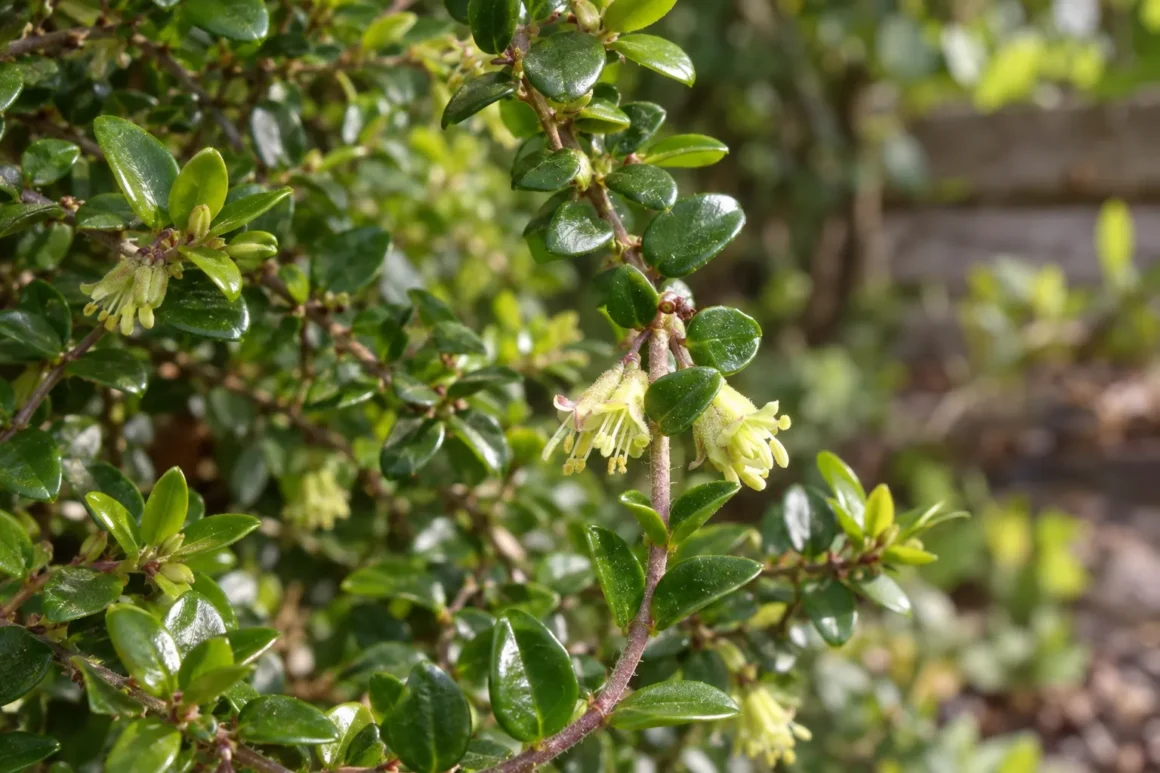
Shrub
Lonicera ligustrina var. pileata
Box-leaved honeysuckle
Also known as: Lonicera pileata
Low, spreading evergreen with tiny glossy leaves on horizontal branches; tough ground cover for sun, shade or coast.
- Full shade, Full sun, Partial shade
- 0.5–1 m (2–3 ft)
- 1.5–2.5 m (5–8 ft)
- H5 · Zone 7
- Evergreen
Overview
Box-leaved honeysuckle, long sold as Lonicera pileata, is a low, spreading evergreen shrub from central and southern China. Its stiff, horizontal branches carry small, glossy, dark green leaves; tiny, scented, creamy flowers in spring are followed by translucent violet berries.
It is hardy to about −15°C (5°F), USDA zones 6–8, and tolerates clay, sand, salt, wind, sun and shade. It grows well in temperate climates and copes with dry shade under trees, but struggles in hot, humid summers. It reaches 50 cm (20 in) to 1 m (3 ft) tall and spreads 1.5–2.5 m (5–8 ft).
At a Glance
Growing Conditions
Aspect Suitability
- North-facing
- East-facing
- South-facing
- West-facing
Site Tolerance
- Exposed sites
- Wind
- Coastal
- Salt
- Drought
Soil Tolerance
- Clay
- Chalk
- Sandy
- Loam
- Acid
- Neutral pH
- Alkaline
Foliage
Foliage interest: 12 months of the year
Seasonal Timeline
- Foliage 12 months of the year
- Propagate Jul Nov
How to propagate
Ways to grow more Box-leaved honeysuckle: the usual steps for each method.
Semi-ripe cuttings Jul Takes a little care
You'll need: Clean, sharp secateurs, small pots, gritty compost, and rooting powder if you have it.
- Choose this year's shoots that are firm at the base but still soft at the tip, and cut pieces 10 to 15 cm long.
- Trim just below a leaf joint and take off the lower leaves; pinch out the soft tip.
- Dip the cut end in rooting powder if you have some.
- Push them into pots of gritty compost, water them in and cover with a clear bag.
- Keep them in a cold frame, greenhouse or bright windowsill out of direct sun.
- How long
- Roots in about 6 to 10 weeks.
- It's worked when
- New leaves, and the cutting resists when you tug it gently.
- Then
- Keep them somewhere cool and frost-free over winter, and pot them up separately in spring.
Hardwood cuttings Nov Easy
You'll need: Secateurs, and a spare corner of soil or a deep pot of gritty compost.
- Once the leaves have fallen, cut pencil-thick stems of this year's growth.
- Cut them into 15 to 25 cm lengths: a sloping cut just above a bud at the top, a straight cut just below a bud at the bottom.
- Push them into a slit in the ground (add some sand to the bottom on heavy soil) or a deep pot, so two-thirds is buried.
- Leave them somewhere sheltered, and water in dry spells.
- How long
- Slow but sure: roots by the following autumn.
- It's worked when
- Leaves in spring, and the cutting holds firm when tugged.
- Then
- Lift them and plant them where they're to grow the following autumn.
Layering Jul Easy
You'll need: A bent wire or tent peg (or a stone), and a small cane.
- Choose a low, bendy stem that reaches the ground.
- Where it touches the soil, scrape away a little bark on the underside, or make a small slanting cut.
- Peg that part down into the soil and cover it, leaving the tip sticking up; tie the tip to a cane.
- Keep it moist.
- How long
- Roots in 6 to 12 months.
- It's worked when
- New growth from the tip, and roots where it was pegged down.
- Then
- Once it has rooted, cut it free from the parent and plant it where you want it.
Roots very easily from cuttings, or from stems pegged down.
Garden Design
Works well in: Modern / Contemporary, Woodland / Shade
Layered, horizontal branches cover banks and fill dry shade under trees.
Companion planting: Ferns, Grasses, Bulbs
Wildlife Value
- Bees
- Birds
- Shelter
Food for birds: September–October