

Evergreen shrub · Houseplant · Tree
Pseudopanax laetus
Big-leaf Pseudopanax
A striking evergreen shrub from New Zealand with huge, glossy, hand-shaped leaves that give real jungle drama to sheltered UK gardens.
- Full sun, Partial shade
- 2–4 m (7–13 ft)
- 1.5–2.5 m (5–8 ft)
- H3 · Zone 9
- May–July
- Evergreen
Overview
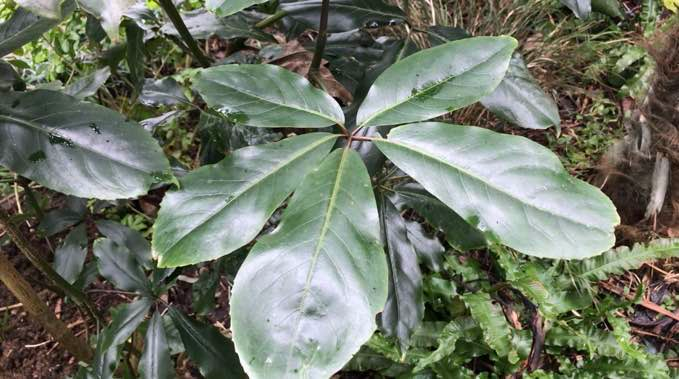
Pseudopanax laetus is an eye-catching evergreen shrub (sometimes grown as a small tree) prized for its bold, leathery leaves, which are divided into five to seven broad, glossy, dark green leaflets with toothed edges. New growth often has a coppery or bronze tinge before maturing to deep green, and the overall effect is wonderfully tropical and architectural, even though the plant hails from the forests of New Zealand rather than the tropics.
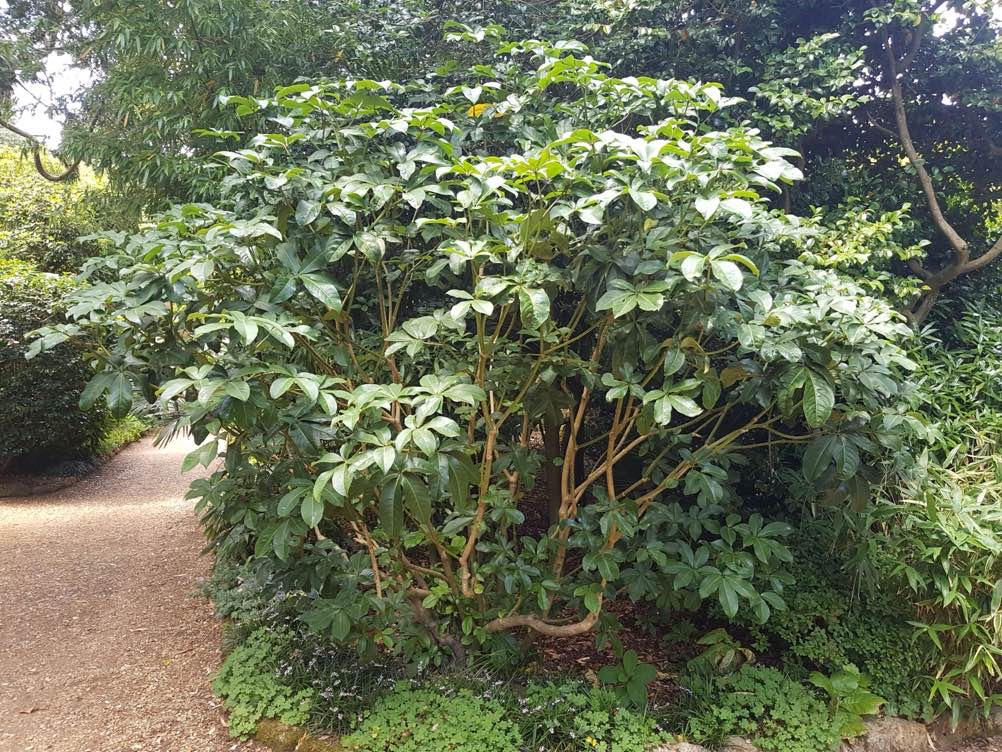
In its native habitat it grows into a small understorey tree, but in UK gardens it is more usually kept as a large shrub, valued for the exotic texture it brings to a border or courtyard. Clusters of small greenish flowers appear on mature plants in late spring or summer, followed by dark berries, though it is really grown for its foliage rather than its blooms.
This is a plant for sheltered, frost-free or nearly frost-free spots, since it is not fully hardy and dislikes cold winds and hard frosts. It does best in a bright, sheltered position with some shade from the harshest midday sun, in moist but well-drained soil enriched with organic matter. Many UK gardeners grow it successfully in a large container that can be moved under cover for winter, making it a popular choice for patios and conservatories as well as mild coastal gardens.
At a Glance
Growing Conditions
Aspect Suitability
- East-facing
- South-facing
- West-facing
Site Tolerance
- Coastal
Soil Tolerance
- Chalk
- Sandy
- Loam
- Acid
- Neutral pH
- Alkaline
Foliage
- Architectural foliage
Foliage interest: 12 months of the year
Seasonal Timeline
- Flowering May Jun Jul
- Foliage 12 months of the year
- Fruiting Sep Oct Nov
- Propagate Mar Apr May Jul Aug Sep
How to propagate
One way to grow more Big-leaf Pseudopanax:
From seed Mar–May Tricky
- Sow about 3 mm deep
- Germinates best at about 19°C
- Comes up in 60–150 days
- Prick out about 8 weeks after sowing
- Pot on about 16 weeks after sowing
- Fresh seed germinates far more reliably than older, dried seed, so sow as soon as you can after collecting ripe berries.
You'll need: Fresh seed, free-draining seed compost, a propagator or warm windowsill, and patience as germination can be slow and uneven.
- Sow seed as fresh as possible, ideally straight after harvesting the purple-black berries in autumn or from a reliable spring batch.
- Clean the pulp off the seed before sowing to reduce rot.
- Sow thinly on the surface of free-draining, gritty compost and cover with a light dusting of fine grit or compost.
- Place in a heated propagator or warm sheltered spot at around 18 to 20 degrees C.
- Keep the compost just moist and be patient, as germination is often slow and erratic, sometimes taking several months.
- Once seedlings have a couple of true leaves, prick them out into individual small pots.
- How long
- Germination is slow and can take anywhere from a few weeks to several months.
- It's worked when
- Look for small palmate seed leaves pushing through the compost surface.
- Then
- Grow young plants on in a sheltered, frost-free spot for at least their first two winters before planting outside, and protect from cold winds while they establish.
Sow fresh seed in spring in a free-draining compost and keep in a warm, sheltered spot under glass, as germination can be slow and erratic. Semi-ripe cuttings taken in late summer with a heel and rooted in a warm propagator offer a more reliable way to reproduce a particular plant's good qualities.
Maintenance Calendar
- Jan Protect from hard frost with fleece or horticultural fleece wrap
- Mar Apply a balanced slow-release fertiliser as growth resumes
- Mar Renew mulch around the base to protect roots
- Apr Plant out new specimens once frost risk has passed
- May Water well during dry spells to settle new growth
- May Check new shoots for aphids and scale insects
- Jun Trim any straggly or damaged growth to maintain shape
- Jul Take semi-ripe cuttings with a heel for propagation
- Aug Water deeply, especially container plants, in dry weather
- Sep Enjoy the ripening purple-black berries, left for birds
- Oct Move container plants to a sheltered spot or greenhouse
- Nov Apply a thick mulch to protect roots over winter
- Dec Keep winter protection in place during frosty spells
Garden Design
Works well in: Modern / Contemporary, Tropical / Exotic, Woodland / Shade
Use as a dramatic focal point in a sheltered courtyard or exotic-style border where its huge glossy leaves can be appreciated up close. Works well underplanted with ferns or shade-tolerant perennials, and makes a striking contrast with fine-textured grasses or bamboos. Needs shelter from cold winds and hard frost, so is best against a warm wall or in a protected urban garden.
Companion planting: Ferns, Grasses, Tree ferns, Bold-leaved exotics, Shade-loving perennials
Wildlife Value
- Bees
- Other pollinators
- Birds
- Beneficial insects
- Shelter
- Food source
- Nesting cover for birds
- Food
Food for birds: September–November
Safety
No significant toxicity is recorded for this plant, though as with any unfamiliar berry it's sensible to discourage children and pets from eating the fruit.