

Shrub
Sabal minor
Dwarf palmetto
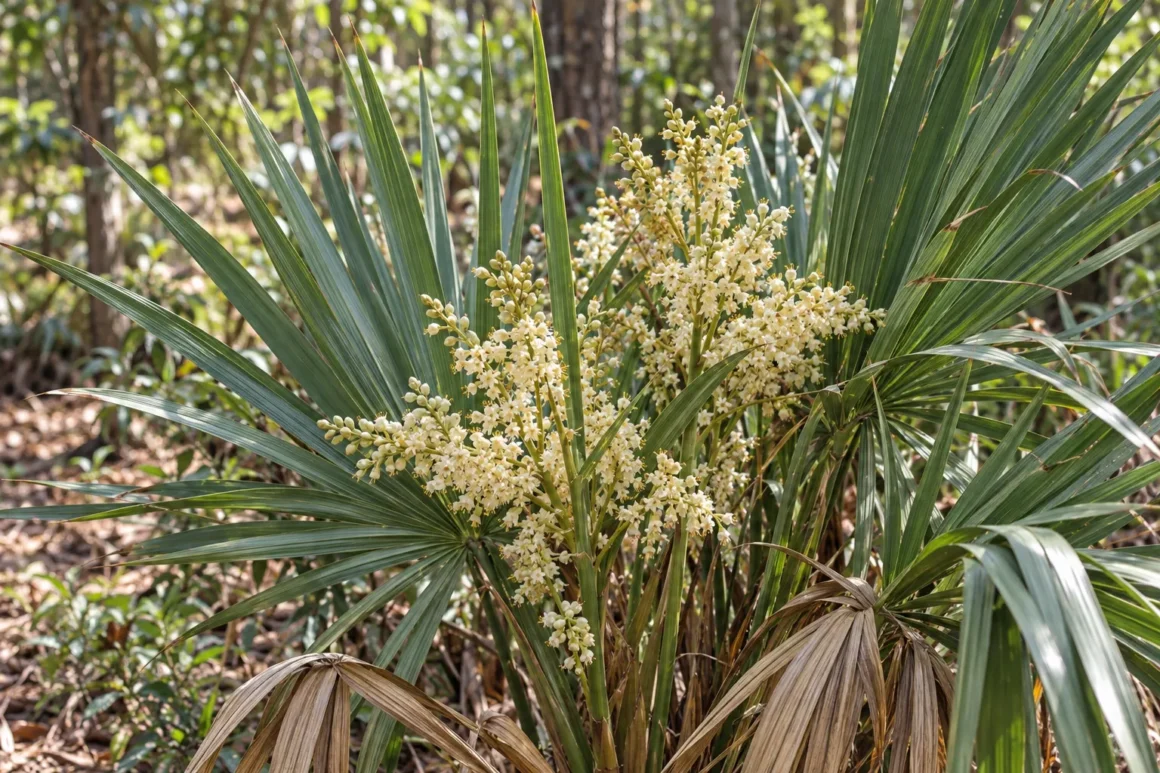
A very hardy, trunkless palm with stiff blue-green fan leaves and tall sprays of fragrant cream flowers.
- Full sun, Partial shade
- 1.5–2.5 m (5–8 ft)
- 1–1.5 m (3–5 ft)
- H5 · Zone 7
- June–July
- Evergreen
Overview
Dwarf palmetto is native to the south-eastern USA and north-eastern Mexico. It usually stays trunkless, forming a clump of stiff, blue-green to green fan leaves, with upright panicles of fragrant cream flowers held above them in summer and shiny black fruits that birds eat.
It is hardy to about −15°C (5°F) or lower, USDA zones 7–10. It grows actively only in real summer heat, so in cool climates it is very slow; in hot, humid summers it does well and tolerates wet, poorly drained soil and some salt.
Grow in sun or part shade in moist soil.
At a Glance
Growing Conditions
Aspect Suitability
- North-facing
- East-facing
- South-facing
- West-facing
Site Tolerance
- Coastal
- Wet soil
Soil Tolerance
- Clay
- Chalk
- Sandy
- Loam
- Acid
- Neutral pH
- Alkaline
Foliage
- Architectural foliage
Foliage interest: 12 months of the year
Seasonal Timeline
- Flowering Jun Jul
- Foliage 12 months of the year
- Fruiting Sep Oct Nov
- Propagate Apr May
How to propagate
One way to grow more Dwarf palmetto: the usual steps for each method.
From seed Apr–May Easy
- Needs light to germinate: press onto the surface, don't cover
- Soak in warm water for 24 hours before sowing
- Germinates best at about 28°C
- Comes up in 30–120 days
- Prick out about 8 weeks after sowing
- Pot on about 30 weeks after sowing
You'll need: Seed compost, a seed tray or small pots, labels, and a clear lid or plastic bag.
- Fill a tray or pots with seed compost, level it and firm it gently.
- Water the compost and let it drain.
- Sow the seeds thinly on top. Cover them with a fine layer of compost or vermiculite about as deep as the seed is big; leave tiny seeds uncovered.
- Label them, cover with a clear lid or bag, and keep them somewhere bright but out of hot sun.
- Keep the compost just moist, and take the cover off once seedlings appear.
- How long
- Usually comes up in 1 to 3 weeks.
- It's worked when
- Seedlings with their first pair of leaves.
- Then
- When each has its first true leaves, prick them out into their own small pots, holding them by a leaf, never the stem. Harden them off for a week or two before planting out.
Fresh seed germinates in warmth in a few months.
Garden Design
Works well in: Tropical / Exotic, Wildlife-friendly, Woodland / Shade
A trunkless palm of stiff blue-green fans, with tall stems of scented cream flowers then black fruits. Very hardy but very slow.
Companion planting: Rhapidophyllum, Ferns, Aspidistras, Yuccas
Wildlife Value
- Bees
- Birds
- Food source
- Food
Food for birds: September–November